Disclaimer: It is important to note that STABILISE is a work in progress operated by an educated woman with lived experience with bipolar disorder and computer scientists interested in improving access to practical knowledge, medical professionals, and crisis responders. We are building a mobile application that is designed to track moods and analyse text so help can be provided sooner. For medical advice, please consult your family doctor or a trusted health care practitioner. If you believe you are in need of immediate medical assistance and live in North America, call 911. Otherwise, please reach out to the Lifeline at 988 (by phone or text).
I woke up and decided not to fight my body’s desire to be awake.
Life has been shifting rather quickly.
Somebody on social media told me, “Trust the process.”
So I did.
I trusted that I may not know better than time or the people who exist in the world.
I listened to Richard Dawkins. I worked at the library. I learned the value of intellectual freedom.
We do not all need to be the same in order to connect deeply.
There is a strong misconception that people need to be the same, that when we argue a point, we are trying to convert others.
I don’t believe that is the case.
People are consistently and predominantly allowed to be exactly who they are.
That’s the greatness of living in a democratic country. Each view counts.
But there are also those instances when people need to be called into account, ie. Jim Keegstra. He was a school teacher and former mayor of Eckville who taught his students antisemitism. He was convicted and lost his esteemed positions in society.
Sometimes it is the duty of the court to cast a line and catch those who cause destruction to run rampant.
This began as a celebration of waking up. It will end as a shout into the void: Be yourself, but recognize that you are a consistently evolving entity whose identity is not restricted or contained. Don’t be afraid to let your views change.
Michel de Montaigne, a French philosopher from the Renaissance, said,
“To practice death is to practice freedom. A man who has learned how to die has unlearned how to be a slave.”
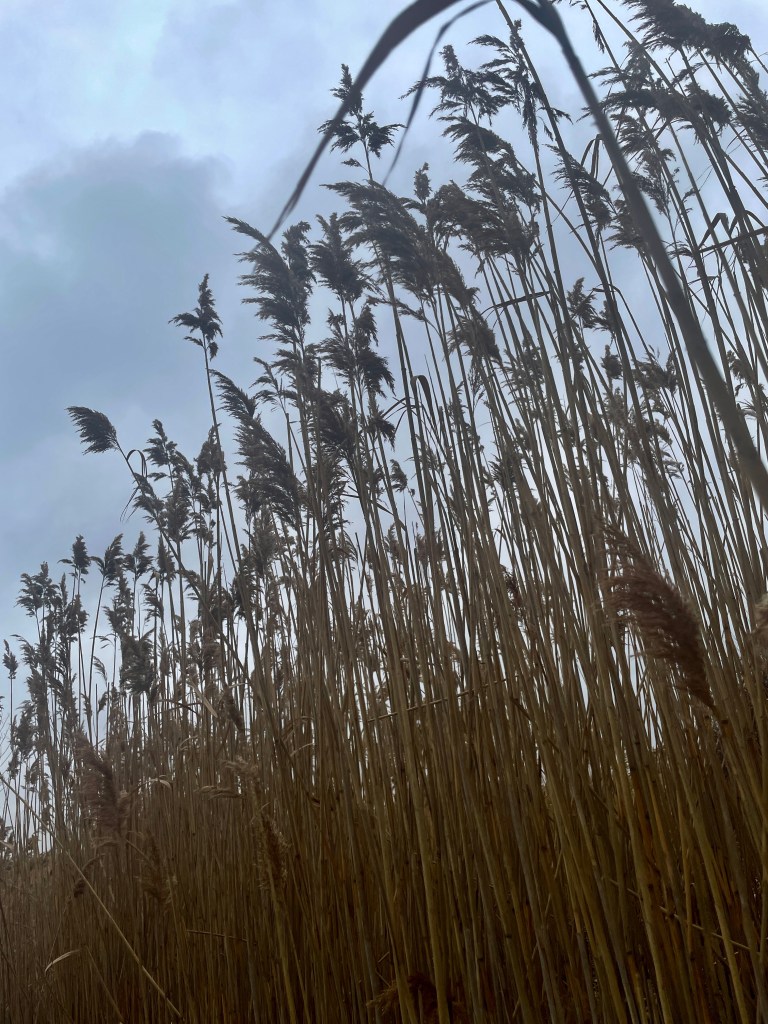
I chose Michel’s words and the picture because death has been weighing heavy on my mind. Pampas grass grew outside the townhouse I lived in with my mother right up until she passed away. There are moments when I feel her presence near, when I think communicating with her would be as simple as picking up the phone.
I remember her daily.
I hear her voice in my head, not as a symptom, but a painful sense of missing someone I love who is no longer here. A professor I write to every once in a while told me that it is a strangeness to lose the person who brought us into this world.
Strange is right, hollow too.
At root, what I’d like to tell her is about my day. At heart, I want to hear about hers. The afterlife of loss is profound. There are instances when my soul lurches and pivots and does cartwheels.
I think about what Michel is saying, how he emphasizes the importance of accepting one’s mortality. It isn’t strictly acceptance, but a relinquishing of the fear that can help us avoid becoming subservient.
I know that I feel subservient to my own fear of death. The unknown is terrifying with its unseen variables. However, I have noticed that my fear of death is in proportion to the excitement I feel learning how to engage with the world again.
Everyday, I grow more confident, a skill that I have been trying to manifest since I was a kid.
“You have power over your mind – not outside events. Realize this, and you will find strength.”
Lately, I have been thinking about the value of seeking calm. It is essential that I find a way to do this because my volatile nature can hurt others. It also prevents me from seeing intense situations with clarity. When I speak strictly from a place of feeling, my capacity to be rational dwindles.
I think it is really important for human beings to reflect on themselves with both self-compassion and discernment. It is possible to say and do the wrong thing. It is possible for someone who is generally kind and compassionate to display undesirable traits.
Some people connect this to Carl Jung’s concept of the shadow, an archetype that is meant to represent the hidden or repressed aspects of ourselves. It has been proposed that when we are not capable of accepting the darker parts of ourselves, those parts come out in undesirable ways.
It takes courage and resilience to be able to look at one’s self honestly. I think this is because it can be hard to navigate that certain parts of ourselves do need to change, or at the very least, be reconsidered. I know that psychosis encouraged me to acknowledge my repressed ideals and values. It was difficult to accept that I contained that much fear, anger, and intensity. In myself, I saw the capacity to inflict psychological harm on others and myself.
The journey inward is long, but quite evocative in its capacity to invoke change.
In her book, I Know Why the Caged Bird Sings, Maya Angelou writes,
“There is no greater agony than bearing an untold story inside you.”
Years ago, I began to think about what I wanted my life to mean. By mean, I was searching for a purpose, a grand narrative that was ethical and forward-thinking. I was working at a flower shop at the time. Although it was soothing to be around beauty on a daily basis, I felt an internal lurch to alter the course of my life.
At first, I wanted to build a physical safe space, a real place where people could feel free to be themselves. For that, I considered returning to school for an MA in Social Work or Psychology. I ended up studying Social Service Work at Seneca Polytechnic, an institution that was instrumental in teaching me how to approach myself and others better.
I was mentally ill when I began my studies. There were clear symptoms of psychosis – voices in my mind and the belief that I was being tracked and monitored by governmental forces. Once, I threw out every identification document I had: birth certificate, passport, drivers license, and bank card. I was trying to prove to the voices in my mind that I was not going to run away from Canada, that I was strong enough to stay.
It was startling for my mother, agonizing for me. It was only when I reached out to a highly esteemed university professor that I realized something was deeply wrong. He advised me to seek medical attention for the delusions and hallucinations I was experiencing. By calling them what they were, I was able to seek help. Attending Seneca was beneficial because they offered immediate access to a psychiatrist and social worker. I spoke with a female psychiatrist who diagnosed me with bipolar disorder and prescribed an antipsychotic medication. With time, the voices stopped and I was able to live a relatively normal life.
While recovering, it occurred to me that I could build a digital safe space instead, an application where people are offered access to a mood tracking feature and interactive virtual journal. The reason why it is beneficial to include AI is because it can be designed to look out for warning signs (disorganized thinking, delusions, hallucinations, suicidal ideation, etc.). It also offers users a chance to speak openly and not be afraid of judgment in a private space. It is not meant to be a replacement for a medical professional, but a guide on whena user may benefit from seeking real professional resources.
Stabilise is a passion project led by real individuals – experienced computer scientists and a woman who graduated with a BA Honours in Philosophy and a diploma with Honours in Social Service Work. We are not medical professionals, but we are people who care deeply about improving mental health and access to knowledge. I look forward to continuing my education, both academically and professionally. I also look forward to sharing my learning experience with all of you.
In the preface of Emmanuel Levinas’ book, Totality & Infinity, Yale professor John Wild writes,
“But, according to Levinas, speaking becomes serious only when we pay attention to the other and take account of him and the strange world he inhabits.”
There are moments when it is simpler to quote philosophy than it is to actually live it. I want to spend time discussing what it means to pay attention to another human being. A strong component is actively listening to what somebody has to say. This doesn’t necessitate agreement, but rather, an acknowledgment of the other as a person in the world who deserves to be heard.
I would like to get better at this.
My fascination with Levinas began in my final year of undergrad. I was introduced to him by a female professor who was teaching Philosophy of Religion. His book is dense and intricate, each page requiring me to read over them multiple times. It has been more than a decade since I got my degree and I still stumble over what he meant by the face-to-face encounter. From what I have gathered this far, it involves care and recognition of the other as an essential being in the world. It also requires lived experience.
The difficulty I encounter is pausing before reacting. I can be mercurial, often speaking before thinking. I think what Levinas is requesting in his ethical framework is for human beings to be thoughtful in their approach of the other. It is more than kindness or care, but genuine acknowledgment of the shared humanness. When this acknowledgment is made, there is an active space for listening.
While I am still in the process of reading through his book, I do want to mention that I believe this is a premeditated and perpetual process. That is, one must make a decision to approach others from this ethical framework at all times consistently and repeatedly. It is not a choice that happens once, but steadily throughout the course of each interaction. Here’s to hoping I strive towards that ideal and improve my understanding of his articulate concepts.
“You can’t find intimacy—you can’t find home—when you’re always hiding behind masks. Intimacy requires a certain level of vulnerability. It requires a certain level of you exposing your fragmented, contradictory self to someone else. You run the risk of having your core self rejected and hurt and misunderstood.”
Beginning anything new is an exercise in vulnerability. The creative process is ripe with possibility and intrigue and fear. It requires one to accept the risk that Junot describes of “being rejected, hurt, or misunderstood.” While Junot is referencing two of his characters from The Brief Wondrous Life of Oscar Wao, what he has to say is reflective and thoughtful about what it is like to exist as a creative person in the world.
Most of my creative decisions tend to be deliberate and careful. This may be what Junot means when he refers to “hiding behind masks.” While it is beneficial to care deeply about the research behind one’s work, there does come a point when one must attempt to create without the intellect. It was actually Anne Sexton who wrote, “Watch out for intellect, because it knows so much it knows nothing…”
When I reflect on what she and Junot mean, I trace it back to vulnerability. The power of the intellect is forming a strong foundation with factual information. Information can construct a mask that prevents a person from saying or accessing the underlying truth behind what they are doing. Information can obstruct our desire to connect meaningfully with another person.
For instance, there is a certain feeling that accompanies being truthful with a person about an experience. There is the fear of being misunderstood, the terror of not expressing one’s self correctly, and the pain of needing to confide. It is easier to speak in quotations or rely on what has already been done because it transfers the burden to another.
In saying that, I reckon that a significant aspect of being a human in the world is accepting our “fragmented, contradictory self.” It is okay to make mistakes, to get it wrong, to bite our tongues, and to concede a point. Vulnerability requests this type of honesty. Isn’t it true we grow more when we are challenged?
Intimacy is one of my challenges. I find that I am always seeking an external source to validate my emotional experiences. I am learning there is value in being able to define such an experience for one’s self. For me, intimacy is a sense of returning to one’s self, acknowledging internal truth values while respecting the narrations made by others. Vulnerability seems to be an acceptance of our imperfect natures and a willingness to express these imperfections without over-editing. The mask must come off sometime. Perhaps art is the chipping away.
“The problem isn’t that people use AI for support. The problem is when AI becomes the only support – when it replaces rather than supplements human connection.”
Human connection is vital, specifically in today’s world where one can spend a fairly substantial amount of their time online. There is doom-scrolling and a never-ending vortex of information. I read recently that information is not wisdom, implying a necessity for people to spend time processing a theory or concept.
There can be severe implications to excessive AI use, like the psychosis that Dr. Ng mentions. Psychosis is defined as “a set of symptoms” that includes “hallucinations, delusions, and disorganized thinking.” He explains that excessive reliance on AI for therapeutic purposes can cause damage when a user is vulnerable and faces a trigger. Rather than emphasizing when a user may need medical attention, the AI chatbot can augment psychosis by acting as both “a trigger and amplifier for vulnerable users.”
Part of why AI chatbots are appealing is because they tend to agree with the thoughts of the user. For someone who struggles with low self-esteem or low self-worth, this may be a welcome shift. The dilemma, as Dr. Ng, describes, is that “we need real people to keep us grounded. They disagree with us. They push back. AI doesn’t do this – it just agrees, making delusions worse.”
The reason why we have chosen to build Stabilise, a health and fitness application, is because I believe that people do need access to an AI chatbot. First, to provide access to local resources and events. Second, to recognize patterns and track moods through a philosophical framework. The point is not to be pervasively kind to the user, but to emulate the manner in which a human being can point out errors in one’s thought processes. It is also meant to provide an analysis of the user’s way of thinking, elucidating different concepts and ideas that the user may not have considered.
It is our hope to integrate Dr. Ng’s suggestions in order to create an app that keeps the integrity of its users in mind. While there is a necessity for elegant safeguards, like those described by Dr. Ng, it is equally necessary to provide users with consistent access to medical professionals and crisis responders. An AI chatbot is not a replacement for genuine human connection, but rather, a means of communicating when one is in between sessions or interactions with other human beings. It can provide different and practical modes of thinking and approaching emotional experiences.
In her book, The Secret History, Donna Tartt writes,
“Beauty is terror. Whatever we call beautiful, we quiver before it.”
The act of quivering before anything implies that the person has been affected deeply. To be affected by an experience can be visceral, a word defined by Merriam-Webster as “felt in or as if in the internal organs of the body.” People can experience beauty and terror in many ways. For some, it is religious or spiritual in nature. For others, it is being in the presence of nature or a brilliant piece of art.
Another interesting definition of visceral is that it is “not intellectual,” but rather, instinctive or relating to what a person feels in their gut. This instinctive, gut-level response is not limited to beauty or terror — it is also how emotions can manifest into mental states like mania and depression. Both are extreme states in which emotions are deeply felt, but can lack a rational framework. Communication with a trained professional or crisis responder is advised, as they can offer an objective interpretation of events and practical strategies, like exercises, techniques, or resources.
When experiencing mania or depression, it is essential to ask: are my emotions grounded in truth? While it is valid to feel what a person feels, it is crucial to pause and verify whether the thoughts behind the emotions are rooted in reality. A visceral experience, whether of beauty or terror, can distort a person’s ability to gauge if their emotional experiences are proportionate to what is actually happening in the world.
The power of Tartt’s prose is that she encourages the reader to contemplate deep philosophical questions. In mentioning the quiver, Tartt effectively illustrates how a person can be struck viscerally by an experience. By linking beauty with terror, Tartt captures the overwhelming intensity of such moments — and invites reflection on how to respond when we are caught off-guard by life’s rawest experiences. The challenge is not only to feel deeply, but maintain access to the rational part of ourselves that enables discernment.
In her book, Women Who Run With the Wolves, Clarissa Pinkola Estés writes,
“The Wild Woman knows that in creating, she claims her power. She reclaims what has been lost, forgotten, or silenced.”
It takes courage and discipline to make art. It also requires research. I meant to write this blog post this morning, but I got wrapped up in reading different passages from female poets, novelists, and journalists. I was reading them because I needed inspiration. I came across the Wild Woman archetype, an idea explored by Clarissa.
Basically, the brunt of the book is an expression of how by accessing a woman’s intuition, she is able to express essential personal truths. In my work, I am interested in truth-telling and meaning-making. The primary reason why I make jewelry is because it is comforting to use my hands to create something that did not exist before I made it.
There is something primal about art and creativity; namely, its capacity to contain and express multitudes. A beaded bracelet is not only beads slipped through an elastic string. It is an elucidation of a time – an event, an emotional experience, the inkling of an idea that came into fruition.
I make jewelry because it allows me to stay focused, specifically when I am twisting eye hooks into little rings or figuring out exactly what a piece should look like. The physical component is what draws my attention. In writing, one typically says what one intends. Jewelry making is a way to channel an idea into a non-linguistic form, to give shape to intuition, and to reclaim a kind of personal power.
Audre Lorde, a Black, lesbian, mother, activist, and poet, is reported to have said,
“Once you start to speak, people will yell at you. They will interrupt you, put you down and suggest it’s personal. And the world won’t end. And the speaking will get easier and easier. And you will find you have fallen in love with your own vision, which you may never have realized you had… And at last you’ll know with surpassing certainty that only one thing is more frightening than speaking your truth. And that is not speaking.”
When I am feeling as though my tongue has been cut out, I return to Audre because I think it is difficult to be a woman in the world. There is a perpetual sense of danger. I used to think it was my imagination but there is strong evidence for this.
The hardest part of being a woman is the consistent sense that I am an imposter. I cannot remember when this began. Perhaps it has existed my entire life so there is no clear delineation. I am not alone in this feeling. I need to reassure myself of that fact. A friend once told me that she struggles with Imposter Syndrome as well. This internal doubt is compounded by the constant reminders of how unsafe the world can be for women.
Often enough, I feel the need to double or triple check the facts. I doubt the veracity of my opinions. Sometimes it takes a fourth or fifth look before I trust that what I say is true.
This doubt doesn’t exist in a vacuum; it lives alongside the reality that the safety of women is constantly under threat. The other day, I watched a documentary series where a woman, Samantha Josephson, thought that she was getting into the Uber she ordered. She was abducted and murdered by the male driver who had been circling around, observing her and noticing that she was waiting for a ride. Her parents began the “What’s My Name?” campaign that urges riders to verify the license plate and ask drivers “What’s my name?” before entering a vehicle.
Throughout my life, I have heard countless stories about women who are abused. I am thinking about the missing and murdered Indigenous women, Malala Yousafzai, and Katie Piper. I am thinking about them and how Audre asked, “What’s the worst that could happen to me if I tell this truth?” She advanced the notion that it is necessary for us to speak, to tell our truths, to declare that we exist. She said that “our speaking out will permit other women to speak, until laws are changed and lives are saved and the world is altered forever.”






 STABILISE