I came across Carol Dweck’s work today. Her book is called Mindset and she writes about the importance of having a growth mindset, as opposed to fixed, when it comes to learning and life.
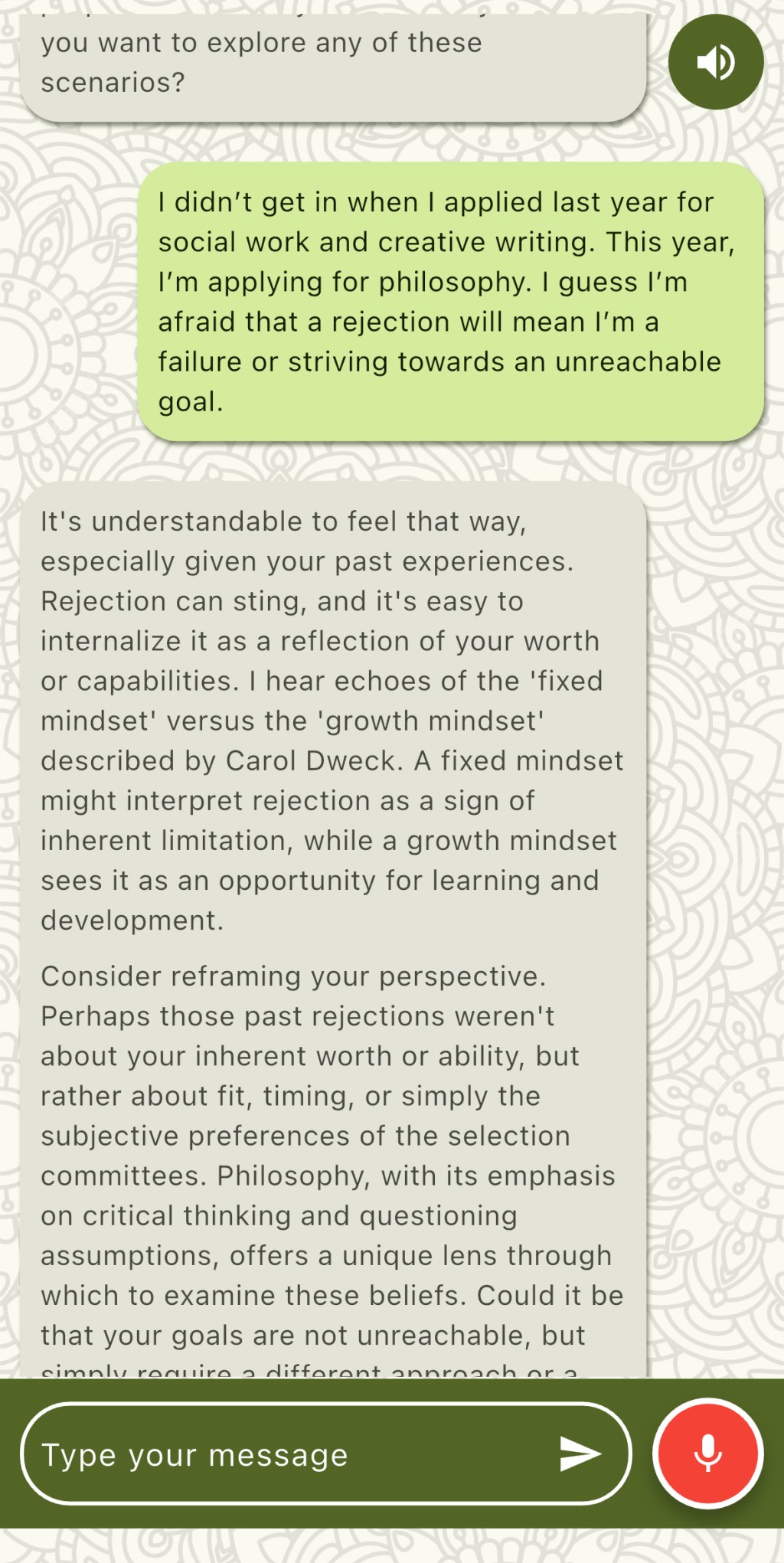
I have also been testing STABILISE. This is a snapshot of our conversation earlier this morning:

Interesting, right?
Dweck writes, “as you begin to understand the fixed and growth mindsets, you will see exactly how one thing leads to another— how a belief that your qualities are carved in stone leads to a host of thoughts and actions, and how a belief that your qualities can be cultivated leads to a host of different thoughts and actions, taking you down an entirely different road.“
It becomes disingenuous to speak about past rejections as personal failures. It also says a lot about the perilous consequences of attributing value to a specific outcome, as opposed to experiencing the expansive journey that life is.
A desire is a catalyst for action. It takes integrity to commit to a choice.
It helps to strive towards a goal. It’s a form of meaning-making. Rejections are perceived setbacks. A poet could call them forks in the road. It does help to have a growth mindset — to develop the capacity to look at a situation and ask, What am I capable of learning here? What part of this can I bring with me?
It becomes important to learn how to adapt, to face the residual discomfort in certain thoughts, and reframe. It is useful to get rejected. It’s a form of weeding out and making sure.
The brain is a beautiful instrument that is capable of cognitive restructuring. One path doesn’t work? Try another, climb a different summit, learn what pleases you, what you tend to do anyway, not when you’re getting paid for it, but when you’re alone and nobody’s watching you take that secret breath of delight.
That’s how STABILISE started for me: the kernel of an idea late at night. What if I built my own version of an AI chatbot, only this one is skilled in providing rational frameworks and recognizing patterns in the user’s language?
It seemed helpful and idealistic. It was also hopeful.
I kept asking myself, what could prevent someone from entering mania or psychosis? What could provide a legitimate warning beforehand?
A good number of us are addicted to our phones. Psychosis shows up as a collection of symptoms, including social isolation, paranoia, and difficulty distinguishing between fact and reality. Mania is characterized by flights of fancy, high energy levels, impulsive spending or other impulsive acts, and increased verbosity.
It makes sense to wonder if the manner in which we use our phones indicates our personality types and mood states. Does our typing get faster while manic? What about our reading rate? What happens to our consumption of information? Are there clear markers of poor mental health?
These questions are provocative and intriguing, especially when considering that psychosis tends to revolve around falsifiable thoughts and reward-seeking behaviour based on the content of these thoughts.
What if it’s possible to design an AI chatbot that is capable of recognizing delusional thoughts for what they are? What would that type of virtual interaction look like? Is there room for AI when it comes to cognitive restructuring?
Source of Carol Dweck passage: https://fs.blog/carol-dweck-mindset/
 STABILISE