Disclaimer: It is important to note that STABILISE is a work in progress operated by an educated woman with lived experience with bipolar disorder and computer scientists interested in improving access to practical knowledge, medical professionals, and crisis responders. We are building a mobile application that is designed to track moods and analyse text so help can be provided sooner. For medical advice, please consult your family doctor or a trusted health care practitioner. If you believe you are in need of immediate medical assistance and live in North America, call 911. Otherwise, please reach out to the Lifeline at 988 (by phone or text).

Category: Philosophy

  • On Learning How to Tell Time Differently

    On Learning How to Tell Time Differently

    “It takes effort to catch yourself before you start retelling the old stories. It takes imagination to see the new story as being real before it has fully manifested. But it’s so worth it when it begins to happen around you and you realize that you don’t even miss the old stories because they never made you happy anyway.”

    Michelle Gordon

    There’s a poem I once read with lines that run through my head even now. It went something along the lines of this:

    “There are voices in the attic. I think they’ve come for me. I hear you laugh, ask if I’m still writing to you, and I guess I must be.”

    Very bad paraphrasing, wish I could locate the piece so I could do it justice, but it was written by a poet on Instagram many years ago whose name I don’t remember.

    Such is life.

    I have been considering the emotional sustenance that comes from cognitive restructuring. I am thinking about those moments when you begin to recognize that the authority to change stems from a series of small steps.

    It is not merely that progress takes time, but often only registers when you realize that the characters have changed. The wording is different.

    Setting and tone are rather important narrative devices. Repetition of the same scene could be construed as insanity, but it could also be the time it takes to realize which parts request modification and integration.

    Sometimes a breath isn’t the act of drawing in air. Sometimes a breath is practicing a new skill, familiarizing yourself with an unfamiliar tool.

    Lay down the chisel, the inner critic, the part of you that asks to be changed. You risk destroying the whole. You risk laser focus on details that actually aren’t all that pertinent. An entire spectrum of colours and techniques to learn instead. Learning anything new takes time.


  • On How a Sentence Begins

    On How a Sentence Begins

    The way we begin a sentence matters, specifically in relation to how we speak about ourselves.

    Consider this:

    “I know I’m awkward but this is x, y, or z,”

    as opposed to,

    “This is x, y, or z.”

    It’s the preface that builds the cage. Not impermeable or unbreakable, but edifying all the same for the one who is listening.

    Consider this too:

    “I know I’m insecure but this is how I feel,”

    as opposed to,

    “This is how I feel.”

    There is an assertion in both of the latter sentences that is not certain to land to the same degree in the former.

    Language is a construct-building system, a web of words that defines points of relations between the two who are in communication.

    It’s a mode of defining the self and when we are self-deprecating, it is often because we want to prove to the other we are aware of our own shortcomings. It’s sort of noble, mostly destructive because we are defining ourselves through a self-imposed constraint. It could also be an illusion, one that we repeat enough times that it gives the impression of a right to speak negatively about ourselves. Enough times and we offer others a right to inaccurate perceptions.

    Skipping past the insecurity is also about ownership and control, maintaining our inherent right to be flawed as a natural precept of being human while just saying the part we feel or mean.

  • On Asking Hard Questions

    On Asking Hard Questions

    How much responsibility can be allocated to an AI chatbot for monitoring someone’s mental health?

    That’s a hard question — a tricky puzzle because it involves a few important factors.

    Let’s say someone is wondering if they are exhibiting signs of depression or mania. They could ask someone in their life to pay attention to their moods and behaviors, they could consult a medical professional, and they could monitor their own moods and behaviors.


    Self-monitoring is a crucial skill to learn.


    The first step is awareness.

    Do you know where you are?

    This is your breath, the part of you that anchors you to earth right now. Not the past, not the future, this moment, the one with features that can be measured.


    One of the reasons why writing is considered to be as therapeutic as it is is because it is a grounding exercise.

    It roots the person in the now, a blank page offering the space needed to express whatever it is the person wants to express.

    The benefit of an AI chatbot, especially one that is well-designed, is that it can serve as a sounding board for ideas, thoughts, and concepts. It can also pinpoint language that indicates professional help may be beneficial.


    Self-monitoring is a crucial skill to learn because the self-observation process ideally helps build recognition of recurring moods and patterns. It also encourages the person to adopt a wide variety of strategies designed to improve one’s mental health. The trick is to learn how to utilize each of them at optimal times.


    I speculate that learning what optimal times means is different for everyone. But on a surface level, it seems as though it would be helpful for people to have an alarm system of sorts. It’s one thing to write that you are feeling depressed, another to have an objective party state that you have expressed feelings of depression for the past three weeks, your steps count has decreased, your heart has not engaged in the same sort of activity for days, and you exhibit signs of social isolation.

    Does it seem disingenuous for personal data to be interpreted and presented by a machine?

    Hard questions, especially when AI hallucinates. The other day, it counted the number of words wrong. Not by a couple of digits, but a couple thousand.

    There is a need for diligence, streamlining, creating spaces for resources that maybe weren’t known before.

    It all becomes very important — the details, I mean.

  • On Perseverance

    On Perseverance

    I came across Carol Dweck’s work today. Her book is called Mindset and she writes about the importance of having a growth mindset, as opposed to fixed, when it comes to learning and life.

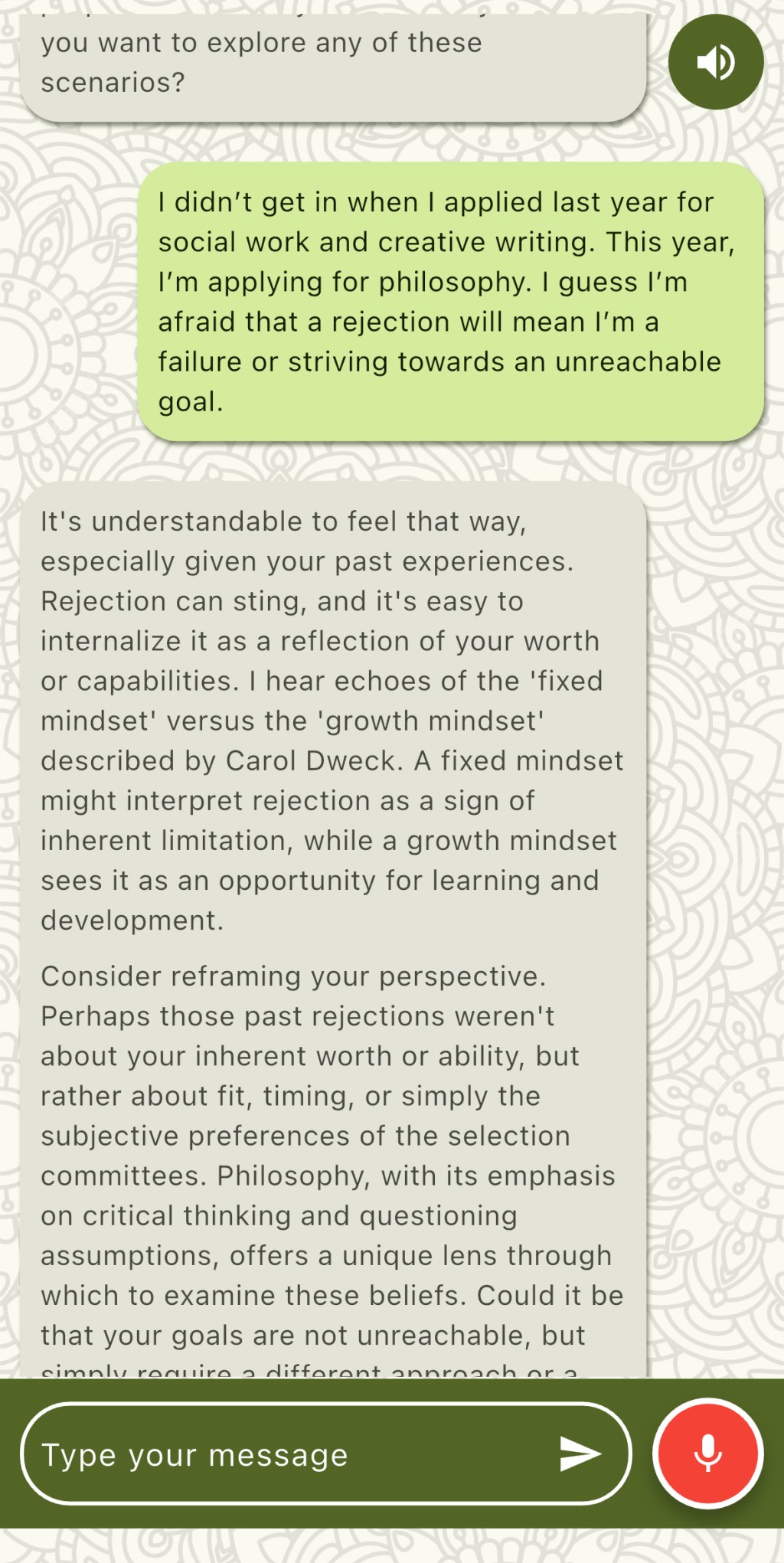
    I have also been testing STABILISE. This is a snapshot of our conversation earlier this morning:

    Interesting, right?

    Dweck writes, “as you begin to understand the fixed and growth mindsets, you will see exactly how one thing leads to another— how a belief that your qualities are carved in stone leads to a host of thoughts and actions, and how a belief that your qualities can be cultivated leads to a host of different thoughts and actions, taking you down an entirely different road.

    It becomes disingenuous to speak about past rejections as personal failures. It also says a lot about the perilous consequences of attributing value to a specific outcome, as opposed to experiencing the expansive journey that life is.

    A desire is a catalyst for action. It takes integrity to commit to a choice.

    It helps to strive towards a goal. It’s a form of meaning-making. Rejections are perceived setbacks. A poet could call them forks in the road. It does help to have a growth mindset — to develop the capacity to look at a situation and ask, What am I capable of learning here? What part of this can I bring with me?

    It becomes important to learn how to adapt, to face the residual discomfort in certain thoughts, and reframe. It is useful to get rejected. It’s a form of weeding out and making sure.

    The brain is a beautiful instrument that is capable of cognitive restructuring. One path doesn’t work? Try another, climb a different summit, learn what pleases you, what you tend to do anyway, not when you’re getting paid for it, but when you’re alone and nobody’s watching you take that secret breath of delight.

    That’s how STABILISE started for me: the kernel of an idea late at night. What if I built my own version of an AI chatbot, only this one is skilled in providing rational frameworks and recognizing patterns in the user’s language?

    It seemed helpful and idealistic. It was also hopeful.

    I kept asking myself, what could prevent someone from entering mania or psychosis? What could provide a legitimate warning beforehand?

    A good number of us are addicted to our phones. Psychosis shows up as a collection of symptoms, including social isolation, paranoia, and difficulty distinguishing between fact and reality. Mania is characterized by flights of fancy, high energy levels, impulsive spending or other impulsive acts, and increased verbosity.

    It makes sense to wonder if the manner in which we use our phones indicates our personality types and mood states. Does our typing get faster while manic? What about our reading rate? What happens to our consumption of information? Are there clear markers of poor mental health?

    These questions are provocative and intriguing, especially when considering that psychosis tends to revolve around falsifiable thoughts and reward-seeking behaviour based on the content of these thoughts.

    What if it’s possible to design an AI chatbot that is capable of recognizing delusional thoughts for what they are? What would that type of virtual interaction look like? Is there room for AI when it comes to cognitive restructuring?

    Source of Carol Dweck passage: https://fs.blog/carol-dweck-mindset/

  • On the Sidelines

    On the Sidelines

    I have been investing a significant amount of thought in my Statement of Interest for grad school applications.

    One version of the truth is that I realized how ill-equipped I was to speak about mental health while building STABILISE without credentials.

    The thing about getting a Masters, specifically in Philosophy, is that it involves specialization. Mental health is a serious concern. It is one thing to read books in your spare time about a specific topic, a complete other to satisfy the requirements that a degree necessitates.

    There are intricacies in the human mind — trip switches and trauma hazards, all of which should be treated with care and applied practical knowledge.

    For instance, I learned about the anterior insula yesterday after reading a Stanford study about a potential cause in the brain for psychosis. The study showed that for those with a rare genetic disease and those who experience psychosis with unknown origin, the anterior insula is responsible for filtering important information about subjective feelings.

    There is a key relationship between the anterior insula and the ventral striatum, which plays a role in reward processing and brings to mind dopamine. This would make sense when considering how antipsychotic drugs, like Abilify, are meant to balance dopamine and serotonin.

    If the anterior insula belongs to the network responsible for interpreting and allocating importance to thoughts and subjective feelings, there is a certain sense of wonder as to why certain falsifiable thoughts pass through and motivate reward-seeking behaviour.

    Is it because those falsifiable thoughts are linked to an adverse childhood experience or event of similar importance? Did substance use have something to do with it? Is there no relation whatsoever and simply a misfiring and mistaken rewiring of a neural pathway in the brain? There is room for error, a probabilistic necessity.

    I am applying to grad school because I enjoy thinking about the relationship between philosophy and psychiatry.

    I wonder if Nesse is right and depression is adaptive because it helps moderate one’s expectations with the world. I wonder if psychosis is adaptive too, and what that adaptive nature would be like written out in the form of a thesis. I know my first impulse is to mention art — not strictly in reference to what can be created with canvas, paint, or material, but expansive enough to include the proof of a theorem.

    Stanford Study: https://med.stanford.edu/news/all-news/2024/04/brain-systems-psychosis.html

  • On Finishing a Sample Paper

    On Finishing a Sample Paper

    Finishing a sample paper to apply for grad school is a bit of a cosmic joke.

    Write 5000-6000 words on a subject that interests you within this field on the off-chance that you will be accepted.

    This is the second year in a row I have applied to grad school. Last year, I applied for an MSW and an MFA in Creative Writing. I got on the waitlist for the MFA that was eventually rejected.

    This year, it’s philosophy. I wrote my paper on the philosophy of mental illness. I included the work of people I didn’t necessarily think I would include, mostly because they present problems.

    Problems are good though. Problems help you get better at adopting new approaches and finding different solutions, sometimes for problems you didn’t even realize you wanted a solution for.

    Plus, a paper, or a philosophical essay, is meant to contain arguments and counterarguments. The point is not necessarily to be right, but to learn how to approach a problem from different angles with fairness and integrity.

    The question I’m ruminating over:

    Why do you even want to go to grad school?

    Luckily, I have the Statement of Interest to write next.

    I want to go to grad school because it proves there is a space for my interests in an academic field. I am interested in research, primarily case studies relating to people who struggle or have struggled with symptoms of psychosis. I am intrigued by the nature of delusions and how lived experience affects the symptoms expressed by a mental illness.

    Primarily though, I am interested in the question: What does an ethical and beneficial therapeutic relationship look like?

    It has been an interesting process. I sent my first draft to a professor for review. I will be sending it to somebody else. I read an article by someone on Substack who wrote that it may be a good idea to adopt a beneficial habit for thirty days and see how our lives are affected.

    Writing this paper made me suspend good self-care by taking over my brain. For the next thirty days, I am committed to performing one daily act of love and gratitude for myself.

  • On Tufts

    On Tufts

    I was able to move on from Chapter 6 of Randolph Nesse’s book, Good Reasons for Bad Feelings. Near the end of Chapter 7, he writes,

    “Patients with depression feel like they are sinking on a small tuft, fearful, often for good reason, of taking that first step into the muck. Leaving a job or marriage with no place else to go can make things worse. Much of the work of therapy is to help people get up the courage to make changes and to help them see other little tufts of grass on the way to higher ground” (135).

    It may be the shifting of the seasons, but I can sense that some part of me is sinking on a small tuft.

    For me, depression is not an anvil on the chest or a cloud of darkness. It is the paralysis of inaction. It is participating in a team-building exercise directed towards acknowledging strengths and not being able to name a single one of mine.

    Nesse goes on to write,

    “Depression is caused by the situation, the view of the situation, and the brain. Treatment can change the situation, the view of the situation, and the brain. However, all three interact in tangled webs of causes, so addressing only one of them will miss many treatment possibilities” (136).

    While sinking on one tuft, it can be simple to narrow focus on the muck. How cold, drab, and gross! A significant part of cognitive restructuring involves being able to perceive a situation from different angles. Sure, this tuft here is sinking, but there is another tuft of grass there. One tuft to another forms rungs on a ladder until there’s stable ground.

    Sometimes the next tuft is gratitude. I mean, sometimes it’s the ability to look at the sky or breathe. Maybe that’s why breathwork is often cited as a useful tool. When there is nothing else, there is the capacity to fill one’s lungs.

    Release before expansion, expansion after release.

    One of my own personal obstacles is wanting to climb an entire mountain in a single swoop. While building STABILISE, our virtual journal and mood tracker, I have been encouraged to learn that small steps lead the way.

    Sure, there may be nicks and tears, but we are closer than we have ever been.

    A fascinating component of Nesse’s work is how often he stresses the depression that accompanies pursuing an “unreachable goal.” Writing the sample paper for grad school and building an application are not unreachable goals. What may be unreachable is thinking either could be done without faltering.

    Sometimes it really is about the moments where you’re stuck, where you’re convinced that you couldn’t possibly know what to do next. So, you read another page or two, you let your ideas simmer, and you make the decision to try again tomorrow.

  • On Grief and Grieving

    On Grief and Grieving

    I began reading The Grieving Brain by Mary-Frances O’Connor who writes,

    “Grieving, or learning to live a meaningful life without our loved one, is ultimately a type of learning. Because learning is something we do our whole lives, seeing grieving as a type of learning may make it feel more familiar and understandable and give us the patience to allow this remarkable process time to unfold.”

    She makes a distinction between grief and grieving. Grief is the pain of memory, the flash of insight that our loved one has passed. Grieving is the process of learning how to live with the loss of our loved one.

    It is fascinating how she compares grieving to learning because it encourages the one who experiences grief to adopt coping mechanisms that allow one to live a whole-hearted life.

    For the past week, I have been remembering how it felt to write when I was young. There was an unencumbered bliss. A significant part of that was reading books and learning how language can be used to create worlds and express ideas.

    I mention writing because it is one of my coping mechanisms, as well as a significant component of the app we are building. Today was the first day I was able to test the app. There are bugs, of course — that was to be expected.

    What I didn’t anticipate was the pervasive sense of loss. I suppose I expected building something out of nothing to feel different, like an incredible accomplishment. I have been thinking about this app for a long time. There is no doubt that it is incredible and beautiful and will be an interesting experience for its users.

    But tomorrow is the second anniversary of my mother’s passing and I wish I could tell her about the development of STABILISE and how I’m applying to grad school and I really did end up studying Levinas on a daily basis.

    It reminds me of that famous line from Into the Wild:

    “Happiness: only real when shared.”

    What happens when one of the people you want to share your life with is dead?

    Yes, I am self-pitying, but what if that is also growth? What if learning how to accept her passing is what allows me to proceed full force ahead for my own sake? What if death teaches us gratitude for the time we had, how to cope with loss, and live into our highest selves anyway?

  • On the Marginal Value Theorem

    On the Marginal Value Theorem

    I am still reading Randolph Nesse’s, Good Reasons for Bad Feelings. I got stuck on Chapter 6, “Low Mood and the Art of Giving Up.”

    He talks about the Marginal Value Theorem, which is mathematical behavioral ecologist Eric Charnov’s solution presented to a question best imagined by you foraging for berries. At first, the berries are easy and delicious to grab. The more time you spend at a particular bush however, the less accessible the berries become.

    At what point do you leave the bush in favour of finding another one?

    The question may really be:

    When do you give up on a goal, dream, or activity?

    Activity could be extended to include a mode of being.

    At what point do you let go?

    I have worked in a haunted house for the last four October’s. I am a flannel-over-a-creepy-dress person. I wear the warmest sweats I’ve got. I pull my socks right up to my knees. When my haunt is empty, I press my left sole into the wall. I stare at the bricks, how some of the markings make them appear to have faces.

    I look at them. I take a deep breath. I check my phone for the thirtieth time that minute. I slip it into my right pocket. I stare at the wall and I ask myself, “Will I come back here next year?”

    The answer presented by Nesse is this:

    “…all the action is at that spot “on the margin” where the rate of getting berries at the current bush dips below the number of berries you can get per hour by moving to a new bush.”

    When debating whether or not I should come back to haunt next year, I count the factors I can measure. There is the fatigue, the exertion that accompanies having three jobs, my desire to be somewhere else next year. I keep joking I’ll be on an island. But I probably will be lying on an island with sand on my knees and the sun shining brightly.

    Walking away from anything you love is hard. Easier to weigh the future, that place that doesn’t exist yet. The value in looking ahead is that it allows us to form conceptions of what we want more. Are your hands tired of being bruised when reaching further and further into the bush?

  • On the Mother Wound

    I am reading a book written by Monika Carless called, Transforming the Mother Wound. Near the beginning, she writes that “self-healing or assisted healing consists of several steps,” one of which is “creating safe space to explore the trauma” (Carless, 10).

    I have been thinking about grief and the desire to disappear from people’s lives. When I was growing up, there were instances when my mother and I would get into disagreements and she would ask me if I wanted her to disappear.

    It is an intense and impactful question that is augmented by the fact that her physical frame has indeed disappeared through death.

    I appreciate John Locke’s popularized notion of tabula rasa, a Latin phrase for blank slate. Locke himself was one of the three great empiricists, a philosophical framework that posits sensory experience as our primary mode of acquiring information and knowledge about the world.

    When I was young, I learned that disappearing is an option. I learned how to ghost and leave people’s lives without a second glance. And yet, it is only now that I feel a strong urge to reprogram my way of thinking.

    The neuroplasticity of our brains means that this is possible. It is one thing to form a habit, another to pay attention to the moment when you are presented with the opportunity to choose a different action. It requires self-awareness, discipline, focus, and a willingness to change.

    Hard emotions demand brevity. I am learning how to stand still in the face of them. I am learning how to trust myself enough to know that even if the ground may shift beneath my feet, I will be okay. I am developing inner fortitude and the realization of control that I have over my own character.

    In this place here, I am learning how to take Carless’ advice and carve a space where I can explore what moves me. I have also started writing by hand in a beautiful journal that was gifted to me.

    My journey is the process of becoming.