Disclaimer: It is important to note that STABILISE is a work in progress operated by an educated woman with lived experience with bipolar disorder and computer scientists interested in improving access to practical knowledge, medical professionals, and crisis responders. We are building a mobile application that is designed to track moods and analyse text so help can be provided sooner. For medical advice, please consult your family doctor or a trusted health care practitioner. If you believe you are in need of immediate medical assistance and live in North America, call 911. Otherwise, please reach out to the Lifeline at 988 (by phone or text).

Author: Fatima Zaghloul

  • On Grief and Grieving

    On Grief and Grieving

    I began reading The Grieving Brain by Mary-Frances O’Connor who writes,

    “Grieving, or learning to live a meaningful life without our loved one, is ultimately a type of learning. Because learning is something we do our whole lives, seeing grieving as a type of learning may make it feel more familiar and understandable and give us the patience to allow this remarkable process time to unfold.”

    She makes a distinction between grief and grieving. Grief is the pain of memory, the flash of insight that our loved one has passed. Grieving is the process of learning how to live with the loss of our loved one.

    It is fascinating how she compares grieving to learning because it encourages the one who experiences grief to adopt coping mechanisms that allow one to live a whole-hearted life.

    For the past week, I have been remembering how it felt to write when I was young. There was an unencumbered bliss. A significant part of that was reading books and learning how language can be used to create worlds and express ideas.

    I mention writing because it is one of my coping mechanisms, as well as a significant component of the app we are building. Today was the first day I was able to test the app. There are bugs, of course — that was to be expected.

    What I didn’t anticipate was the pervasive sense of loss. I suppose I expected building something out of nothing to feel different, like an incredible accomplishment. I have been thinking about this app for a long time. There is no doubt that it is incredible and beautiful and will be an interesting experience for its users.

    But tomorrow is the second anniversary of my mother’s passing and I wish I could tell her about the development of STABILISE and how I’m applying to grad school and I really did end up studying Levinas on a daily basis.

    It reminds me of that famous line from Into the Wild:

    “Happiness: only real when shared.”

    What happens when one of the people you want to share your life with is dead?

    Yes, I am self-pitying, but what if that is also growth? What if learning how to accept her passing is what allows me to proceed full force ahead for my own sake? What if death teaches us gratitude for the time we had, how to cope with loss, and live into our highest selves anyway?

  • On the Marginal Value Theorem

    On the Marginal Value Theorem

    I am still reading Randolph Nesse’s, Good Reasons for Bad Feelings. I got stuck on Chapter 6, “Low Mood and the Art of Giving Up.”

    He talks about the Marginal Value Theorem, which is mathematical behavioral ecologist Eric Charnov’s solution presented to a question best imagined by you foraging for berries. At first, the berries are easy and delicious to grab. The more time you spend at a particular bush however, the less accessible the berries become.

    At what point do you leave the bush in favour of finding another one?

    The question may really be:

    When do you give up on a goal, dream, or activity?

    Activity could be extended to include a mode of being.

    At what point do you let go?

    I have worked in a haunted house for the last four October’s. I am a flannel-over-a-creepy-dress person. I wear the warmest sweats I’ve got. I pull my socks right up to my knees. When my haunt is empty, I press my left sole into the wall. I stare at the bricks, how some of the markings make them appear to have faces.

    I look at them. I take a deep breath. I check my phone for the thirtieth time that minute. I slip it into my right pocket. I stare at the wall and I ask myself, “Will I come back here next year?”

    The answer presented by Nesse is this:

    “…all the action is at that spot “on the margin” where the rate of getting berries at the current bush dips below the number of berries you can get per hour by moving to a new bush.”

    When debating whether or not I should come back to haunt next year, I count the factors I can measure. There is the fatigue, the exertion that accompanies having three jobs, my desire to be somewhere else next year. I keep joking I’ll be on an island. But I probably will be lying on an island with sand on my knees and the sun shining brightly.

    Walking away from anything you love is hard. Easier to weigh the future, that place that doesn’t exist yet. The value in looking ahead is that it allows us to form conceptions of what we want more. Are your hands tired of being bruised when reaching further and further into the bush?

  • On Self-Development

    On Self-Development

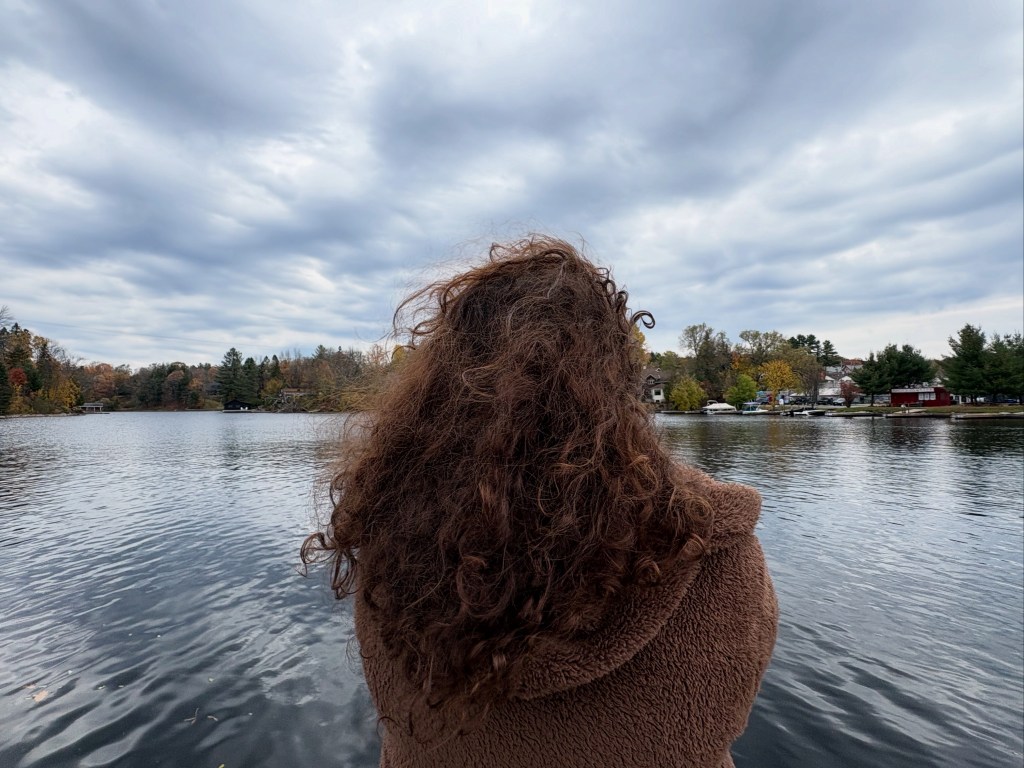
    A very dear friend of mine and I went to Muskoka, Ontario for the weekend. We walked into the Walmart and there was a photo development center through the entrance on our left. It brought to mind memories; namely, how many disposable cameras I used to bring in to photo labs when I was young.

    When I was young, I loved quite fiercely. I loved the skies, trains, mountains, forests, billboards, tracks, getting on a plane and heading somewhere for an indeterminate amount of time.

    Time has become a dark room.

    I am thinking about the clouds we saw on our trip and the clouds I saw at a haunted house later. They were moving quickly, shapeshifting in grey sky before drifting into a dark night.

    I am drenched in memories, both near and far.

    I returned home. I swept the floor before mopping. I rearranged the furniture. There is a new leaf on the ficus. I hung the pothos on thumbtacks along the wall.

    New patterns, new modes of being.

    I got up to clean the toilet, sprayed bleach on the dark brown stain in the sink from the hair dye I applied two weeks ago. I thought about a person I knew who reached out in the thick of spontaneity and ended us by saying, “You haven’t changed.”

    I thought of the tailspin of loss — how we can want what isn’t good for us, how we can want what makes us sick. Head spinning, ghastly shadows, and still we want until we train our minds in the shape of our bodies.

    This here, that there — wooden picks delineating space.

    I get up. I sit down. I look at the watermelon quartz pendant I attached to a black chain. I look at the paint on the canvas, the dollar store sponges that are waiting to be rinsed.

    I look at the evidence of a life and I notice that it’s mine.

    This here, this is self-development.

  • On Loneliness

    On Loneliness

    In his book, A History of My Brief Body, Billy-Ray Belcourt writes,

    “Let’s start with the body, for so much is won and lost and lost and lost there.

    I was lonely once and that was all it took. A thick haze, a smothering opacity, this was the loneliness of feeling estranged from one’s body and, by extension, the world.”

    It astounds me how certain books arrive at the right time.

    It can be easy to think that one is alone with their thoughts, but a distinctive part of becoming an integrated human being is realizing that the majority of us share the experience of loneliness.

    It is a profound feeling, one that reverberates through the body. It is a sacred calling for an honest answer, one that sets the brain ablaze in search of the questions that are being asked.

    Am I enough? Am I enough as I am? What does being enough mean?

    – Samples

    It is sacred work to attempt to discover the questions and answers for one’s self. I don’t believe there is a single response. Rather, I believe the answers fluctuate depending on the times in which the questions are being asked. The objective may be to recognize that truths echo through one’s frame in an intuitive form of knowing.

    The confusion is the desire that stems from loneliness or an equivocal feeling. Hence, the persistent emphasis on meditation and the powerful effects of grounding. To return to the earth is to return to the body. It is to gain the capacity to name loneliness without trying to eradicate it.

    Let the world be what it is. Let yourself be in the world as you are. Loneliness only seems to carry a stench when it leads you to sacrifice your morals and principles. Hence, the persistent emphasis on forming intentions and setting a schedule and learning the power of self-discipline.

    Control thyself — or learn how to pause before acting on an impulse. Act on the impulse anyway to learn the difference between doing and not doing.

    Reading Belcourt’s memoir reminds me how veracious we can be when we offer ourselves the time to examine why we do the things we do. You, dear reader, must be familiar with the sort of doing I am mentioning: the unmentionable acts, the times we contort our physical bodies into shapes beyond our comprehension and recognition, the willful negligence of self in the name of self-expansion. When the self is lonely, it is hard to see clearly.

    Loneliness, in and of itself, is not negative. It carves a space, one in which it is possible to interrogate what to do with the absence and the excess. Self-expansion can often look like self-destruction in the before.

  • On Pursuing Stability

    Today, I had the opportunity to get to know my supervisor better. His name is Imran Somji and he is the founder of Appanzee Inc., the app development company responsible for building STABILISE, among various others.

    We were talking about professional goals and he shared a post he had written about his own layoff story in 2022. It was an inspiring read, though slightly harrowing in the sense that being laid off is rarely conducive for producing a good feeling the moment it happens. It was Nietzsche however, who wrote, “One must have chaos to give birth to a dancing star” (Thus Spoke Zarathustra).

    Depth is often borne from hardship. There are a number of striking features about Imran’s story, which can be read here. Multiple aspects touched me, including this piece of advice:

    “…every now and then I do a deep-dive well outside of my comfort zone.”

    An integral part of being let go is the space it carves for personal growth. Being laid off, no matter how much one may have expected it, is a nudge towards the unknown.

    I remember standing at the foot of a diving board when I was young. I stood at the bottom near the ladder for quite some time. My heart was in a race against my mind. I crept up the rungs eventually, terrified when my bare feet touched the edge of the board. I walked to the front, took many deep breaths, and didn’t jump for a few minutes.

    As Imran writes,

    “Inertia and the feeling of security can hamper your creativity and potential.”

    One of the perils of remaining in a stagnant state for the sake of security is that it eliminates potential and creativity bit by bit.

    Not jumping into the water would have meant that I would never experience how it feels to dive into a pool: the breathless descent before my skin feels the crush of the pool against my skin, the scent of chlorine, the sensation of my feet hitting the bottom, the rise up.

    I would have remained suspended between pensiveness and action. A safe space, but novelty makes room for understanding that newness may be the strongest precursor for learning helpful skills and developing adaptability.

    Source: My Layoff Story by Imran Somji

  • On the Mother Wound

    I am reading a book written by Monika Carless called, Transforming the Mother Wound. Near the beginning, she writes that “self-healing or assisted healing consists of several steps,” one of which is “creating safe space to explore the trauma” (Carless, 10).

    I have been thinking about grief and the desire to disappear from people’s lives. When I was growing up, there were instances when my mother and I would get into disagreements and she would ask me if I wanted her to disappear.

    It is an intense and impactful question that is augmented by the fact that her physical frame has indeed disappeared through death.

    I appreciate John Locke’s popularized notion of tabula rasa, a Latin phrase for blank slate. Locke himself was one of the three great empiricists, a philosophical framework that posits sensory experience as our primary mode of acquiring information and knowledge about the world.

    When I was young, I learned that disappearing is an option. I learned how to ghost and leave people’s lives without a second glance. And yet, it is only now that I feel a strong urge to reprogram my way of thinking.

    The neuroplasticity of our brains means that this is possible. It is one thing to form a habit, another to pay attention to the moment when you are presented with the opportunity to choose a different action. It requires self-awareness, discipline, focus, and a willingness to change.

    Hard emotions demand brevity. I am learning how to stand still in the face of them. I am learning how to trust myself enough to know that even if the ground may shift beneath my feet, I will be okay. I am developing inner fortitude and the realization of control that I have over my own character.

    In this place here, I am learning how to take Carless’ advice and carve a space where I can explore what moves me. I have also started writing by hand in a beautiful journal that was gifted to me.

    My journey is the process of becoming.

  • On Self-Compassion

    Today, I would like to perform an excavation.

    I have lived with crippling self-doubt for too long and I would like it to end.

    As this idea simmers in my mind, I am reminded of Kristin Neff’s work on self-compassion. Reading her work has been a pivotal part of my journey because she teaches her readers how to counter negative thoughts with compassion that is directed inwards.

    I am an extremely self-critical person. Not just sometimes, but practically everyday at regular intervals. It helps to say that out loud. I am critical. I am mean. I am mean to the point where I self-sabotage relationships and experiences.

    Neff writes,

    “We can’t always get what we want. We can’t always be who we want to be. When this reality is denied or resisted, suffering arises in the form of stress, frustration, and self-criticism. When this reality is accepted with benevolence, however, we generate positive emotions of kindness and care that can help us cope.”

    She raises two important questions:

    1.) What do you want?

    2.) Who do you want to be?

    They give me pause.

    I want to be at peace in my head. I want to be a confident and intelligent woman. I want to get my Masters in Philosophy. I eventually want to get my PhD. I want to learn how to love people well and wisely. I want to be kind and thoughtful and considerate. I want to stop wanting to disappear from people’s lives whenever my emotions grow large.

    God, it feels so good to admit all of that, and that’s barely scraping the surface of my wants. But in reference to what she wrote, there are moments when I will not be what or who I want. I will be unkind and inconsiderate and pretentious. I will say stupid things and not read an article carefully enough. My research will be misguided and I will make false assumptions. I will tell someone I care about, “I want to disappear from your life.” I may not get into grad school.

    And I will survive.

    I will survive because I am not a static entity. I am a consistently evolving human being who is capable of tremendous growth and genuine progress. When I wanted to go to college at 35, I doubted my intellectual capacity. I went anyway. I thrived. I met people who will be my friends for the rest of my life. I moved provinces. I shifted my entire life in the direction of a single dream: get educated and strive towards a better life.

    If that is not a signal fire for hope, I am not sure what is.

    I deserve to offer myself compassion because imperfection is a human condition. A constant preoccupation with efficiency is the enemy of magic. I am allowed to love myself fiercely in the face of my misgivings and shortcomings because I am also wonderful.

    Here’s to dipping out of work early to enjoy the October sun and hear the pleasant crunch of leaves underneath my sneakered feet.

  • On Nausea

    Years ago, I stumbled across a memorable quote from Jean-Paul Sartre’s book, Nausea:

    “It’s quite an undertaking to start loving somebody. You have to have energy, generosity, blindness. There is even a moment right at the start where you have to jump across an abyss: if you think about it you don’t do it”.

    It is interesting to consider the initial moment when you recognize there is the potential to love somebody. I am not strictly talking about romantic love, but platonic love as well.

    Vulnerability can feel scary. To put yourself out there, to drop your guard, to show up with an open heart – these are tremendous tasks.

    It calls to mind Kierkegaard’s conception of the leap of faith in his book, Fear and Trembling. This is a logical comparison given that both Sartre and Kierkegaard were continental thinkers.

    In Fear and Trembling, Kierkegaard talks about the leap of faith, a decision that separates the knight of infinite resignation from the knight of faith. Basically, the knight of infinite resignation is the one who doesn’t jump. He approaches the precipice and is paralyzed by its depth and the potential for danger. In comparison, the knight of faith is the one who knowingly makes the leap.

    What I am learning is how to practice awareness while appreciating love’s capacity to inspire joy, peace, and gentleness. There is value in letting somebody in long enough to get to know them. Some people are beacons of light and arbiters of hope. They walk with you on life’s journey.

    It is not a perfect venture. Love is messy. It makes demands. It asks questions, hard questions, the sort that encourage you to take a good, long look at yourself in the mirror. There are conflicts, crises of conscience, and requests for compromise.

    All is well though when you choose to make the leap for those who allow you to feel safe and heard. Love is a communion between two beings who are committed to showing up for each other with respect, integrity, and dignity.

  • On Progress

    A significant part of recovering from a traumatic event is learning how to step outside the framework of pain. It sounds simple, but I am not sure that it is. If it was, then it wouldn’t have taken me from 2019 until now to heal from my first experience with psychosis. To hear voices in your head that do not exist is a tremendous experience. The hardest part of my journey has been learning how to trust my own mind again.

    John F. Nash Jr., the Nobel Prize winner in Economics, suffered from schizophrenia for years before eventually finding his own way to live a stable life. He was institutionalized, offered antipsychotic medication, and insulin shock therapy. In his own words, he found his way when he “began to intellectually reject some of the delusionally influenced lines of thinking which had been characteristic of my orientation. This began, most recognizably, with the rejection of politically-oriented thinking as essentially a hopeless waste of intellectual effort.”

    I find writing about my experiences with psychosis painful because I feel as though it makes me appear weak. When I read about people like John Nash or Mark Vonnegut however, I begin to find my footing. Real people suffer from real mental health concerns. In 1959, John Nash got up to make a lecture at Columbia University for the American Mathematical Society and it was incomprehensible. That is how the public began to understand that something was deeply wrong. Imagine that: a mathematical genius getting up to prove a mathematical hypothesis and inadvertently disclosing that he thought he was a part of a government conspiracy.

    What I have learned from his experience is to cease self-judgment. There is no sense in crucifying myself for trusting voices that came from the same place as my rational ideas. It is okay to get it wrong sometimes, to make mistakes, to flounder. As Maya Angelou wrote, “But still, like dust, I’ll rise.”

  • On Embracing the Quiet

    There is something to be said about being able to exist in the quiet revolutions of change.

    It is possible to slow down, to take a minute to breathe.

    This morning, I was walking to work and I could feel exhaustion creeping its way through my entire body. I asked myself, Do you want to go home and rest or do you want to power through?

    For the first time in years, I called in sick, grabbed a coffee, and returned home.

    I have been considering how only a week or two ago, I was frantic with worry.

    Reading and writing have offered me an opportunity to digest other people’s views while expanding my own.

    I have made the decision to apply for my Masters in Philosophy. I intend on writing about psychosis, mental illness, and the role that cultural frameworks plays in both.

    There is a profound liberation in releasing old paradigms. Not everything that you believe is true, is.

    I have missed this part of my personality deeply, the girl who wanted to follow her dreams wherever they might take her.