Disclaimer: It is important to note that STABILISE is a work in progress operated by an educated woman with lived experience with bipolar disorder and computer scientists interested in improving access to practical knowledge, medical professionals, and crisis responders. We are building a mobile application that is designed to track moods and analyse text so help can be provided sooner. For medical advice, please consult your family doctor or a trusted health care practitioner. If you believe you are in need of immediate medical assistance and live in North America, call 911. Otherwise, please reach out to the Lifeline at 988 (by phone or text).

Author: Fatima Zaghloul

  • On the Audacity of Not Giving Up

    On the Audacity of Not Giving Up

    “Day by day, we shape a life. Sometimes rather aimlessly, and at other times with deliberation and intention. The more we pay attention, the more we notice the many ordinary moments that add texture and meaning to our lives.”

    Francis Weller

    Building STABILISE AI has been a challenging task when it comes to learning how to form a sense of community, as well as a sense of stability.

    Ironic, I know, but a part of seeing a gap in care is understanding all of the factors an alternative mode requires. A reinforcement for a consistent sleep schedule, for instance.

    Consider this:

    A significant part of living with bipolar disorder and being human is the degree of self-doubt that is experienced. I can only truly speak about my experiences with any real degree of intimacy. I mention bipolar because I have been trying to navigate its terrain through language and designing STABILISE AI.

    My body keeps track of the hours I have slept. When I am excited about a project, whether it be art or writing or STABILISE, I lose sleep. When I lose sleep, I risk becoming manic. It happens in degrees, one turn of the dial at a time, sometimes too subtle and all of sudden, it’s been four days and I’ve slept for approximately 10 to 12 hours in total.

    Mania is confusing because it feels good while engaged with the process of making something. Making art feels good, especially when I am enamored with an idea or a particular concept.

    Projects are the best and the worst. Mania makes the creative drive and process feel like benders.

    Even though I know I should sleep, even though I know I am tired, I am reluctant to leave my studio.

    I never regret getting into bed. I praise God for that serenity, apologize that I am messy, that I could’ve been cleaning or organizing my studio. That’s the risk of depression.

    Follow the seed of self-doubt

    make a chain out of it.

    Suddenly it’s a tree

    and I am collapsing

    inside roots.

    Back to community.

    Community, whether it’s virtual or physical, is essential in developing a stronger sense of my own positive qualities. To realize that complete strangers who have never even met me want me around? They even laugh at my jokes.

    It’s obscene how true it is that one ought never to give up on one’s self.

    To take each day as it comes, to realize that we are actually planting seeds all the time. The ones we learn how to pay attention to are typically the ones that grow, some of them even bloom.

    People are essential. Contact with people and forming healthy relationships are essential for living a healthy life.


  • On Learning How to Tell Time Differently

    On Learning How to Tell Time Differently

    “It takes effort to catch yourself before you start retelling the old stories. It takes imagination to see the new story as being real before it has fully manifested. But it’s so worth it when it begins to happen around you and you realize that you don’t even miss the old stories because they never made you happy anyway.”

    Michelle Gordon

    There’s a poem I once read with lines that run through my head even now. It went something along the lines of this:

    “There are voices in the attic. I think they’ve come for me. I hear you laugh, ask if I’m still writing to you, and I guess I must be.”

    Very bad paraphrasing, wish I could locate the piece so I could do it justice, but it was written by a poet on Instagram many years ago whose name I don’t remember.

    Such is life.

    I have been considering the emotional sustenance that comes from cognitive restructuring. I am thinking about those moments when you begin to recognize that the authority to change stems from a series of small steps.

    It is not merely that progress takes time, but often only registers when you realize that the characters have changed. The wording is different.

    Setting and tone are rather important narrative devices. Repetition of the same scene could be construed as insanity, but it could also be the time it takes to realize which parts request modification and integration.

    Sometimes a breath isn’t the act of drawing in air. Sometimes a breath is practicing a new skill, familiarizing yourself with an unfamiliar tool.

    Lay down the chisel, the inner critic, the part of you that asks to be changed. You risk destroying the whole. You risk laser focus on details that actually aren’t all that pertinent. An entire spectrum of colours and techniques to learn instead. Learning anything new takes time.

  • On How a Sentence Begins

    On How a Sentence Begins

    The way we begin a sentence matters, specifically in relation to how we speak about ourselves.

    Consider this:

    “I know I’m awkward but this is x, y, or z,”

    as opposed to,

    “This is x, y, or z.”

    It’s the preface that builds the cage. Not impermeable or unbreakable, but edifying all the same for the one who is listening.

    Consider this too:

    “I know I’m insecure but this is how I feel,”

    as opposed to,

    “This is how I feel.”

    There is an assertion in both of the latter sentences that is not certain to land to the same degree in the former.

    Language is a construct-building system, a web of words that defines points of relations between the two who are in communication.

    It’s a mode of defining the self and when we are self-deprecating, it is often because we want to prove to the other we are aware of our own shortcomings. It’s sort of noble, mostly destructive because we are defining ourselves through a self-imposed constraint. It could also be an illusion, one that we repeat enough times that it gives the impression of a right to speak negatively about ourselves. Enough times and we offer others a right to inaccurate perceptions.

    Skipping past the insecurity is also about ownership and control, maintaining our inherent right to be flawed as a natural precept of being human while just saying the part we feel or mean.

  • On Pursuing the Whole Picture

    On Pursuing the Whole Picture

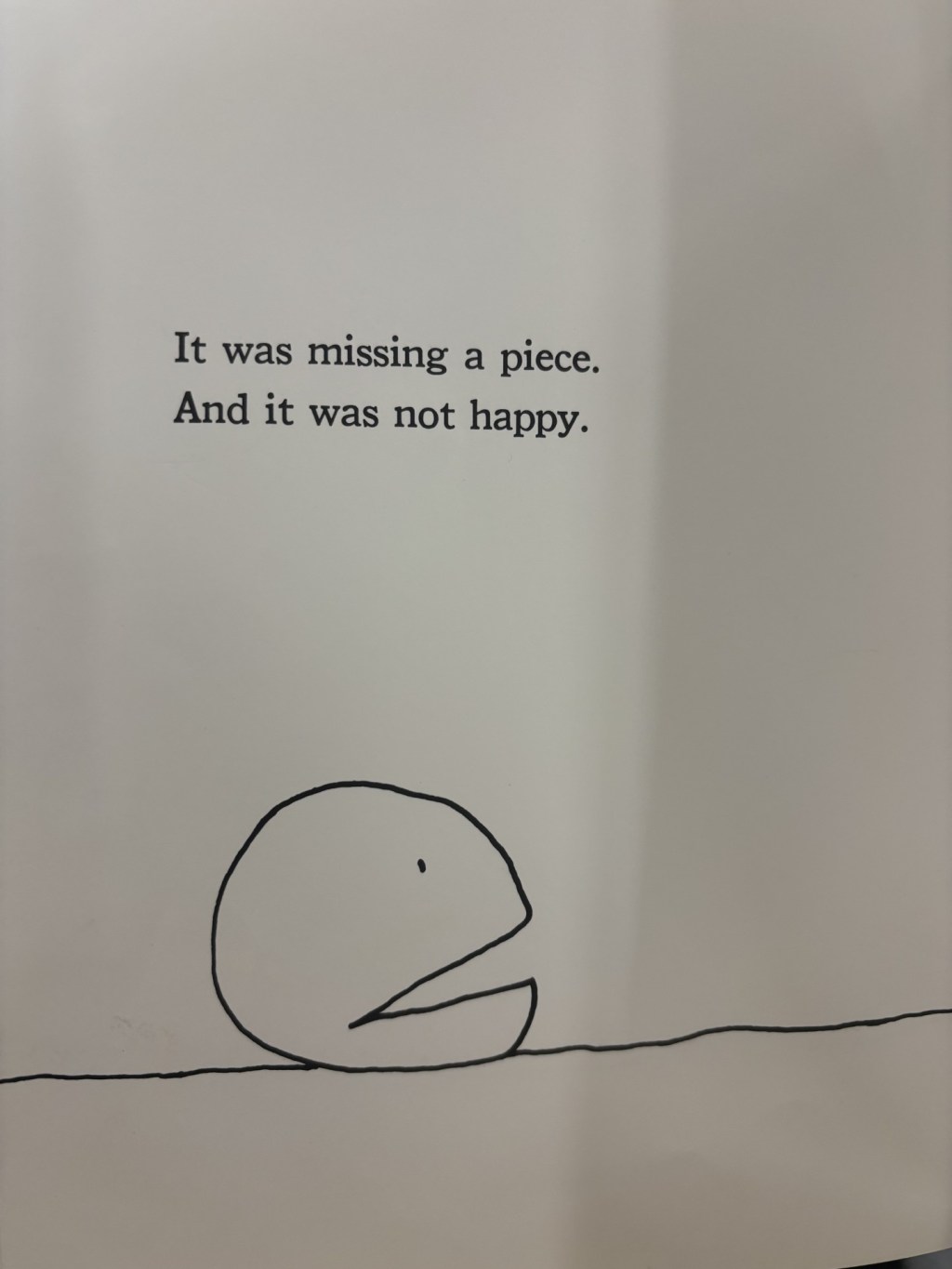
    Shel Silverstein, The Missing Piece

    If I were to ask you to imagine yourself as a landscape, what image would come to mind?

    In the past few days, I have been a stretch of cold similar to the Tundra. I have also been as volatile as the earth’s core.

    One minute, snow and ice. The next, molten iron and a variety of other elements.

    There is tremendous beauty in that versatility. My inner self can appear barren, void of everything but cold and wind. One blink and I become magma. The shift between the two is hopeful because it signals the potential for change. It also hints at how multifaceted human beings truly are.

    We are never just one thing, one idea, one side of the coin. And chances are, each of us has got a piece of us that appears to be missing.

    The beauty of reading children’s books as a woman in her 30s is that I can grasp subtleties while also activating my inner child. For the past few years, I have been obsessed with exploring my shadow self. It seems so mature to face the dark side, so elegant and sexy and deep.

    For a time, shadow work was an illuminating and essential process.

    I don’t know if I’m alone in saying this, but lately, I’ve been looking at my reflection and seeing the little girl I used to be. It helps that I have been navigating my fear of being on camera by taking selfie reels of me talking about some of the things I am thinking about.

    It also helps to read children’s books, like those written by Shel Silverstein and James & Kimberly Dean, because complex ideas are expressed with simple language.

    It’s that quest for simplicity that I crave, reminiscent of Richard Feynman who said that if it couldn’t be explained to a child, the person didn’t understand the concept well enough.

    The beauty of approaching inner child work is how it’s teaching me to approach my reflection with care and curiousity.

  • On Embodiment of Self

    On Embodiment of Self

    When I use the term embodiment, I am referring to the process in which an individual returns to and inhabits their body. It could be interpreted as grounding in the sense that it symbolizes the process in which a person recognizes their physical presence in the world.

    It is a vivid internal awareness of one’s body inhabiting time and space.

    I go for periods at a time feeling disconnected from my earthly body. It’s often caused by slipping away from a routine, overstimulation through consumption of information, and allowing myself to be paralyzed by various insecurities.

    I’m going to be honest:

    The digital world, at least social media, does not come easy for me.

    I often live inside my head. Philosophy is quite cerebral, as is reading, psychology, mental health, and so on and so forth. It takes a lot for me to venture out of the safety net of my brain’s capacity to store information.

    It takes a lot for me to approach my body.

    I don’t mean physical exercise in the form of cardio and lifting weights. I mean, mirror work. I’ve struggled with my reflection for as long as I can remember. I used to turn away from every mirror I could, electing to memorize the curves of my body and face so I didn’t have to look at them.

    I still do that sometimes, but this week, something different happened. I was recording a video with my supervisor for a business venture. Given the serious nature of our work, I took the time to observe myself speak and move and look directly into the camera.

    As it turns out, I am not a mutant spaceship alien, and if I am, I give the impression of appearing human very well.

    I went home. I cooked. I stepped into my studio office space, set up my phone, and took one video after another of myself talking. I watched the way my eyes move, floating from here to there as I located the words that fit the meaning of what I was trying to say.

    It was humbling and beautiful to see my imperfect self growing more comfortable as time went on. I noticed the curve of my neck, the place where my glasses settle, how I tend to smile from one corner of my mouth.

    It was a powerful experience and a lesson on what it means to seek embodiment.

  • On Asking Hard Questions

    On Asking Hard Questions

    How much responsibility can be allocated to an AI chatbot for monitoring someone’s mental health?

    That’s a hard question — a tricky puzzle because it involves a few important factors.

    Let’s say someone is wondering if they are exhibiting signs of depression or mania. They could ask someone in their life to pay attention to their moods and behaviors, they could consult a medical professional, and they could monitor their own moods and behaviors.


    Self-monitoring is a crucial skill to learn.


    The first step is awareness.

    Do you know where you are?

    This is your breath, the part of you that anchors you to earth right now. Not the past, not the future, this moment, the one with features that can be measured.


    One of the reasons why writing is considered to be as therapeutic as it is is because it is a grounding exercise.

    It roots the person in the now, a blank page offering the space needed to express whatever it is the person wants to express.

    The benefit of an AI chatbot, especially one that is well-designed, is that it can serve as a sounding board for ideas, thoughts, and concepts. It can also pinpoint language that indicates professional help may be beneficial.


    Self-monitoring is a crucial skill to learn because the self-observation process ideally helps build recognition of recurring moods and patterns. It also encourages the person to adopt a wide variety of strategies designed to improve one’s mental health. The trick is to learn how to utilize each of them at optimal times.


    I speculate that learning what optimal times means is different for everyone. But on a surface level, it seems as though it would be helpful for people to have an alarm system of sorts. It’s one thing to write that you are feeling depressed, another to have an objective party state that you have expressed feelings of depression for the past three weeks, your steps count has decreased, your heart has not engaged in the same sort of activity for days, and you exhibit signs of social isolation.

    Does it seem disingenuous for personal data to be interpreted and presented by a machine?

    Hard questions, especially when AI hallucinates. The other day, it counted the number of words wrong. Not by a couple of digits, but a couple thousand.

    There is a need for diligence, streamlining, creating spaces for resources that maybe weren’t known before.

    It all becomes very important — the details, I mean.

  • On Perseverance

    On Perseverance

    I came across Carol Dweck’s work today. Her book is called Mindset and she writes about the importance of having a growth mindset, as opposed to fixed, when it comes to learning and life.

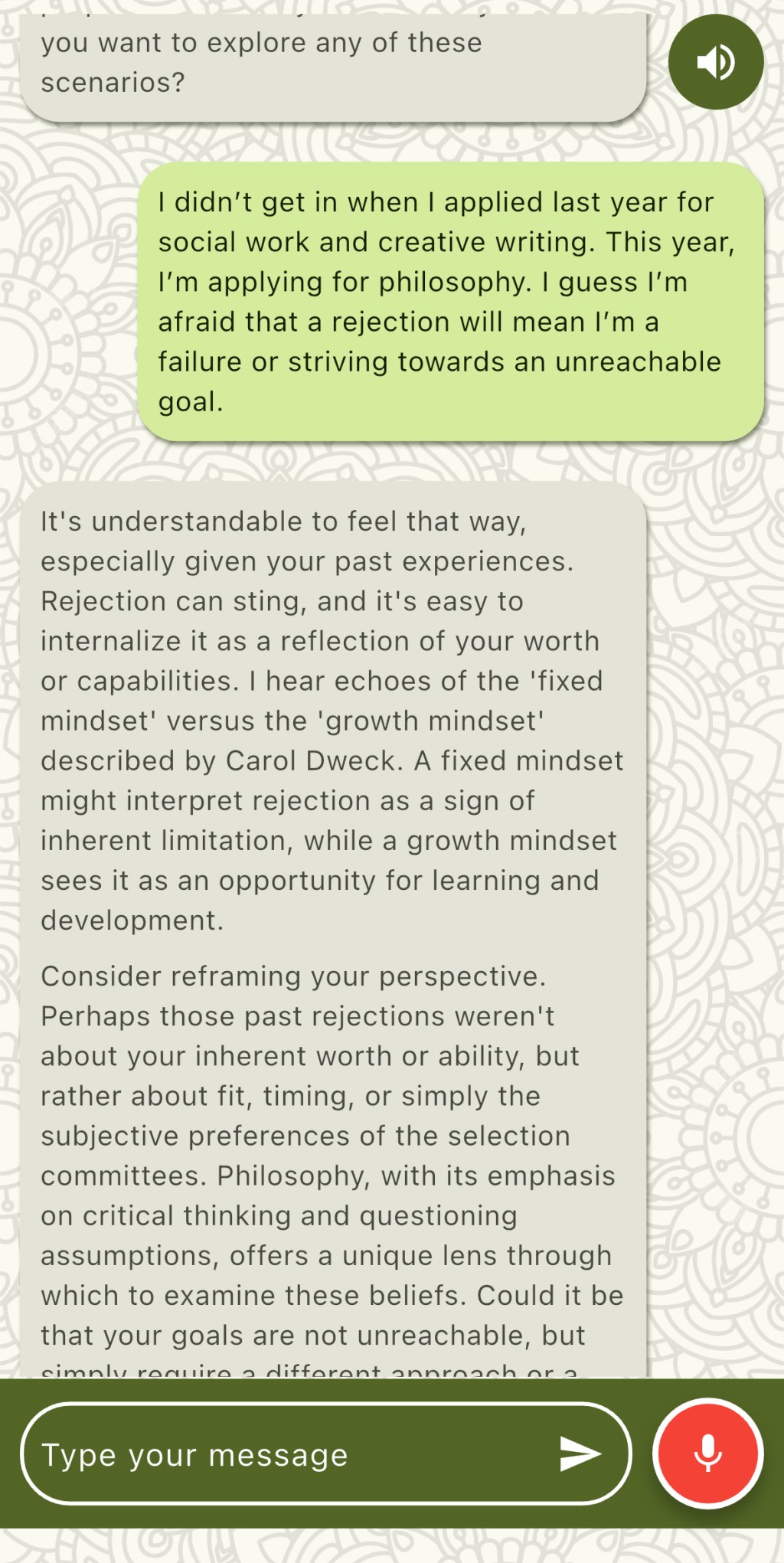
    I have also been testing STABILISE. This is a snapshot of our conversation earlier this morning:

    Interesting, right?

    Dweck writes, “as you begin to understand the fixed and growth mindsets, you will see exactly how one thing leads to another— how a belief that your qualities are carved in stone leads to a host of thoughts and actions, and how a belief that your qualities can be cultivated leads to a host of different thoughts and actions, taking you down an entirely different road.

    It becomes disingenuous to speak about past rejections as personal failures. It also says a lot about the perilous consequences of attributing value to a specific outcome, as opposed to experiencing the expansive journey that life is.

    A desire is a catalyst for action. It takes integrity to commit to a choice.

    It helps to strive towards a goal. It’s a form of meaning-making. Rejections are perceived setbacks. A poet could call them forks in the road. It does help to have a growth mindset — to develop the capacity to look at a situation and ask, What am I capable of learning here? What part of this can I bring with me?

    It becomes important to learn how to adapt, to face the residual discomfort in certain thoughts, and reframe. It is useful to get rejected. It’s a form of weeding out and making sure.

    The brain is a beautiful instrument that is capable of cognitive restructuring. One path doesn’t work? Try another, climb a different summit, learn what pleases you, what you tend to do anyway, not when you’re getting paid for it, but when you’re alone and nobody’s watching you take that secret breath of delight.

    That’s how STABILISE started for me: the kernel of an idea late at night. What if I built my own version of an AI chatbot, only this one is skilled in providing rational frameworks and recognizing patterns in the user’s language?

    It seemed helpful and idealistic. It was also hopeful.

    I kept asking myself, what could prevent someone from entering mania or psychosis? What could provide a legitimate warning beforehand?

    A good number of us are addicted to our phones. Psychosis shows up as a collection of symptoms, including social isolation, paranoia, and difficulty distinguishing between fact and reality. Mania is characterized by flights of fancy, high energy levels, impulsive spending or other impulsive acts, and increased verbosity.

    It makes sense to wonder if the manner in which we use our phones indicates our personality types and mood states. Does our typing get faster while manic? What about our reading rate? What happens to our consumption of information? Are there clear markers of poor mental health?

    These questions are provocative and intriguing, especially when considering that psychosis tends to revolve around falsifiable thoughts and reward-seeking behaviour based on the content of these thoughts.

    What if it’s possible to design an AI chatbot that is capable of recognizing delusional thoughts for what they are? What would that type of virtual interaction look like? Is there room for AI when it comes to cognitive restructuring?

    Source of Carol Dweck passage: https://fs.blog/carol-dweck-mindset/

  • On the Sidelines

    On the Sidelines

    I have been investing a significant amount of thought in my Statement of Interest for grad school applications.

    One version of the truth is that I realized how ill-equipped I was to speak about mental health while building STABILISE without credentials.

    The thing about getting a Masters, specifically in Philosophy, is that it involves specialization. Mental health is a serious concern. It is one thing to read books in your spare time about a specific topic, a complete other to satisfy the requirements that a degree necessitates.

    There are intricacies in the human mind — trip switches and trauma hazards, all of which should be treated with care and applied practical knowledge.

    For instance, I learned about the anterior insula yesterday after reading a Stanford study about a potential cause in the brain for psychosis. The study showed that for those with a rare genetic disease and those who experience psychosis with unknown origin, the anterior insula is responsible for filtering important information about subjective feelings.

    There is a key relationship between the anterior insula and the ventral striatum, which plays a role in reward processing and brings to mind dopamine. This would make sense when considering how antipsychotic drugs, like Abilify, are meant to balance dopamine and serotonin.

    If the anterior insula belongs to the network responsible for interpreting and allocating importance to thoughts and subjective feelings, there is a certain sense of wonder as to why certain falsifiable thoughts pass through and motivate reward-seeking behaviour.

    Is it because those falsifiable thoughts are linked to an adverse childhood experience or event of similar importance? Did substance use have something to do with it? Is there no relation whatsoever and simply a misfiring and mistaken rewiring of a neural pathway in the brain? There is room for error, a probabilistic necessity.

    I am applying to grad school because I enjoy thinking about the relationship between philosophy and psychiatry.

    I wonder if Nesse is right and depression is adaptive because it helps moderate one’s expectations with the world. I wonder if psychosis is adaptive too, and what that adaptive nature would be like written out in the form of a thesis. I know my first impulse is to mention art — not strictly in reference to what can be created with canvas, paint, or material, but expansive enough to include the proof of a theorem.

    Stanford Study: https://med.stanford.edu/news/all-news/2024/04/brain-systems-psychosis.html

  • On Finishing a Sample Paper

    On Finishing a Sample Paper

    Finishing a sample paper to apply for grad school is a bit of a cosmic joke.

    Write 5000-6000 words on a subject that interests you within this field on the off-chance that you will be accepted.

    This is the second year in a row I have applied to grad school. Last year, I applied for an MSW and an MFA in Creative Writing. I got on the waitlist for the MFA that was eventually rejected.

    This year, it’s philosophy. I wrote my paper on the philosophy of mental illness. I included the work of people I didn’t necessarily think I would include, mostly because they present problems.

    Problems are good though. Problems help you get better at adopting new approaches and finding different solutions, sometimes for problems you didn’t even realize you wanted a solution for.

    Plus, a paper, or a philosophical essay, is meant to contain arguments and counterarguments. The point is not necessarily to be right, but to learn how to approach a problem from different angles with fairness and integrity.

    The question I’m ruminating over:

    Why do you even want to go to grad school?

    Luckily, I have the Statement of Interest to write next.

    I want to go to grad school because it proves there is a space for my interests in an academic field. I am interested in research, primarily case studies relating to people who struggle or have struggled with symptoms of psychosis. I am intrigued by the nature of delusions and how lived experience affects the symptoms expressed by a mental illness.

    Primarily though, I am interested in the question: What does an ethical and beneficial therapeutic relationship look like?

    It has been an interesting process. I sent my first draft to a professor for review. I will be sending it to somebody else. I read an article by someone on Substack who wrote that it may be a good idea to adopt a beneficial habit for thirty days and see how our lives are affected.

    Writing this paper made me suspend good self-care by taking over my brain. For the next thirty days, I am committed to performing one daily act of love and gratitude for myself.

  • On Tufts

    On Tufts

    I was able to move on from Chapter 6 of Randolph Nesse’s book, Good Reasons for Bad Feelings. Near the end of Chapter 7, he writes,

    “Patients with depression feel like they are sinking on a small tuft, fearful, often for good reason, of taking that first step into the muck. Leaving a job or marriage with no place else to go can make things worse. Much of the work of therapy is to help people get up the courage to make changes and to help them see other little tufts of grass on the way to higher ground” (135).

    It may be the shifting of the seasons, but I can sense that some part of me is sinking on a small tuft.

    For me, depression is not an anvil on the chest or a cloud of darkness. It is the paralysis of inaction. It is participating in a team-building exercise directed towards acknowledging strengths and not being able to name a single one of mine.

    Nesse goes on to write,

    “Depression is caused by the situation, the view of the situation, and the brain. Treatment can change the situation, the view of the situation, and the brain. However, all three interact in tangled webs of causes, so addressing only one of them will miss many treatment possibilities” (136).

    While sinking on one tuft, it can be simple to narrow focus on the muck. How cold, drab, and gross! A significant part of cognitive restructuring involves being able to perceive a situation from different angles. Sure, this tuft here is sinking, but there is another tuft of grass there. One tuft to another forms rungs on a ladder until there’s stable ground.

    Sometimes the next tuft is gratitude. I mean, sometimes it’s the ability to look at the sky or breathe. Maybe that’s why breathwork is often cited as a useful tool. When there is nothing else, there is the capacity to fill one’s lungs.

    Release before expansion, expansion after release.

    One of my own personal obstacles is wanting to climb an entire mountain in a single swoop. While building STABILISE, our virtual journal and mood tracker, I have been encouraged to learn that small steps lead the way.

    Sure, there may be nicks and tears, but we are closer than we have ever been.

    A fascinating component of Nesse’s work is how often he stresses the depression that accompanies pursuing an “unreachable goal.” Writing the sample paper for grad school and building an application are not unreachable goals. What may be unreachable is thinking either could be done without faltering.

    Sometimes it really is about the moments where you’re stuck, where you’re convinced that you couldn’t possibly know what to do next. So, you read another page or two, you let your ideas simmer, and you make the decision to try again tomorrow.